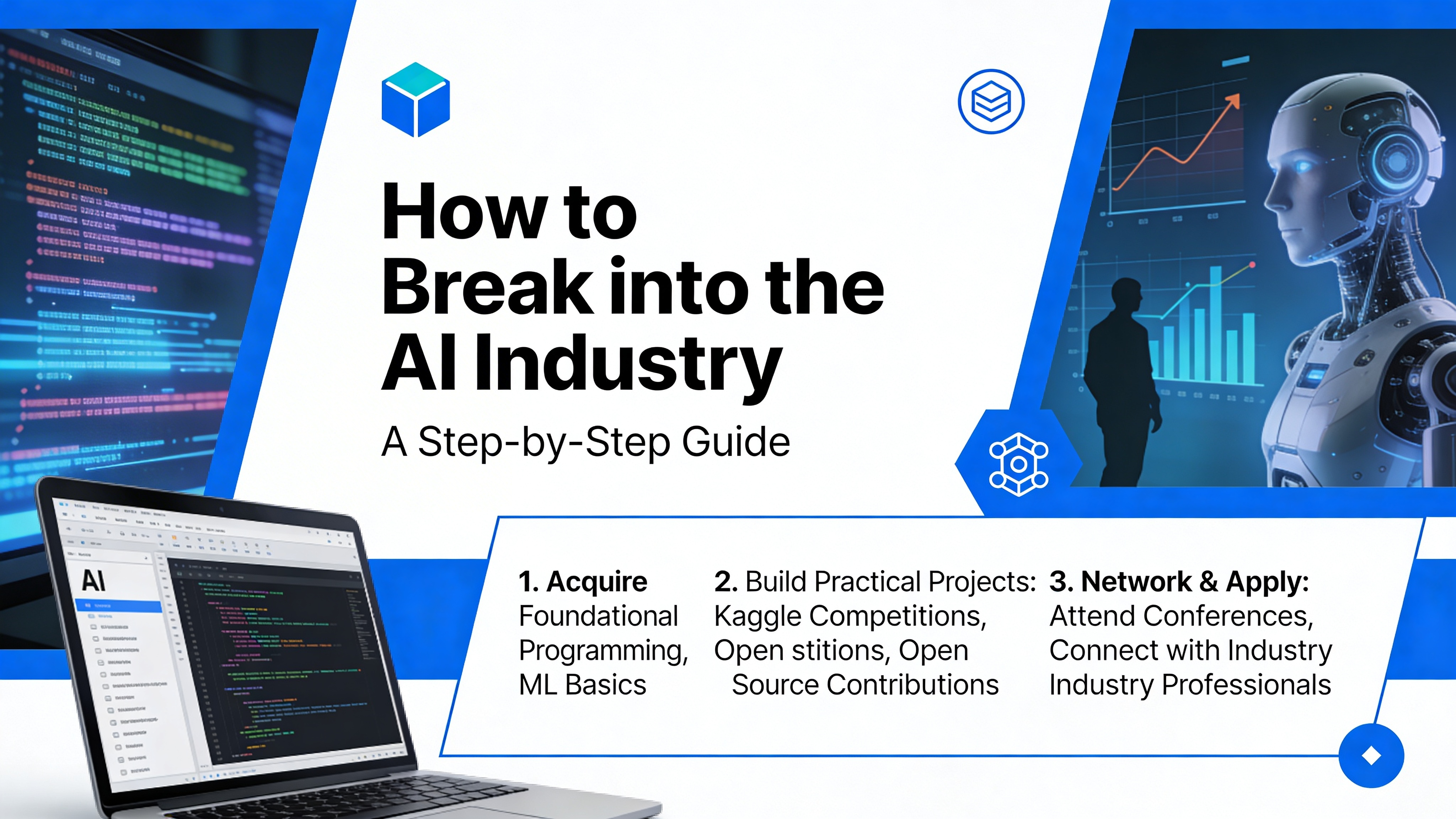
Entering the AI industry is not about quick learning or trend-chasing—it is about cultivating long-term competitiveness, problem-solving ability, and adaptability in a rapidly changing field. Success comes not from what you know today, but from how you grow and create value over time.
1. Focus on Fundamentals, Not Just Tools
2. Specialize to Become Irreplaceable
AI is too broad for generalists. The most valuable professionals choose a clear direction and deepen their expertise:
Technical fields: NLP, computer vision, large language models, multimodal AI
Industry applications: healthcare, finance, education, manufacturing, retail
Functional roles: AI product, MLOps, data strategy, prompt engineering, AI governance
Specialization turns you from a participant into a key contributor.
3. Build a Portfolio of Impact, Not Just Projects
In AI, employers care about what you can solve, not what you can code. A strong portfolio shows real outcomes: improved efficiency, reduced costs, better user experience, or measurable business value. Whether you are an engineer building end-to-end systems or a professional designing AI-driven solutions, tangible results will always stand out.
4. Understand the Whole AI System
Top performers in AI do not work in isolation. They understand the full lifecycle: data collection, labeling, preprocessing, modeling, evaluation, deployment, and iteration. They also understand how technology connects to business goals. This holistic perspective makes you more collaborative, decisive, and ready for leadership roles.
5. Combine Domain Knowledge with AI
The greatest opportunity in AI is industry + AI. If you have experience in any field, you do not need to become a full-time coder. Instead, become the person who knows how to apply AI to solve real industry pain points. This hybrid advantage is rare and highly demanded by companies.
6. Enter Through Practical Entry Points
You do not need to be an expert to start. Begin with accessible roles such as data annotation, prompt engineering, AI operations, or junior AI analysis. These positions let you enter the industry, learn from experienced teams, and gradually upgrade your skills while working.
7. Embrace Ethics and Continuous Learning
AI evolves extremely quickly, so lifelong learning is essential. Equally important is ethical awareness: understanding bias, privacy, safety, and social responsibility. As AI becomes more regulated, professionals with both technical skill and moral judgment will have the brightest future.
8. Aim for Long-Term Growth, Not Quick Success
A career in AI is a marathon, not a sprint. Success comes from consistent improvement, clear positioning, real projects, and steady value creation. With patience, focus, and purpose, anyone can build a stable and meaningful career in the AI industry.
Here are a few AI products
https://createanimagewithbing.com/
https://ai-babygenerator.com/
https://idm-vton.online/
https://flirtypickuplines.com/
https://resuma.net/
https://wordcam.net/
https://createanimagewithbing.com/
https://imagetranslator.vip/
https://mei-tu.vip/
https://sunoaimusic.vip/
https://photo-booth.vip/
https://pics-art.net/
https://bingimagecreator.vip/
https://pngcompressor.cc/
https://usernamegenerator.cc/
https://kindergartensightwords.com/
https://additiontables.com/
https://subtractiontables.com/
https://times-table.com/
https://trigonometry.top/
https://footballbros.co/
https://polytrack.vip/
https://kartbros.cc/